The Njoku
of Buea
The sacred elephant · Bakweri people · South West, Cameroon
Buea
Location
Bakweri
Indigenous people
Njoku
Sacred name of the elephant
The Maale
Dedicated ritual dance
How a monument was born
“Arrh Njoku!”
Those bananas were worth all the gold in the world
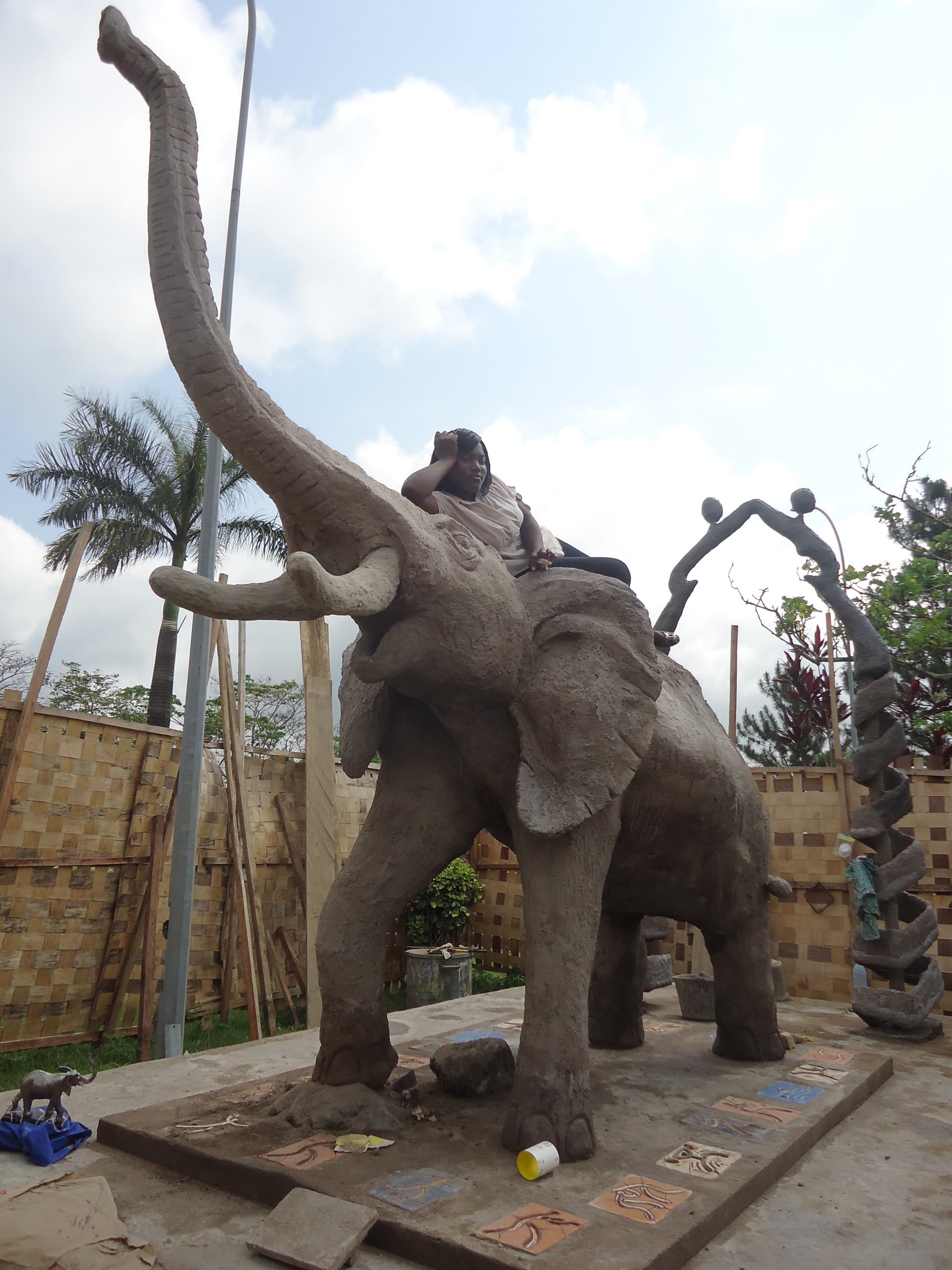
Njoku — that is what the Bakweri, the indigenous people of Buea, call the elephant. And for NOUMSI KEMEGNE NADÈGE, this monument is one of the most beautiful she has ever created — not because of its size, but because of what it stirred in people's hearts.
While the work was under way, women from the neighbourhood would walk past. As soon as they recognised the shape of the elephant taking form, they cried out with fervour: “Arrh Njoku!”. Then they came up to the artist and said:
“My daughter, we have nothing of great value to give you, but you are doing us a great honour. Take these bananas.”
Those bananas given from the heart — along with the kola nuts and the smiles of the elderly women who came back day after day — were worth far more, in NOUMSI's eyes, than all the money she received for the monument. This spontaneous ritual of gratitude was repeated until the work was finished, with different women each time, coming to honour their symbol reborn in stone and bronze.
It was only by looking into it afterwards that the artist understood the full scale of what she had achieved. The Njoku is not just an animal in Bakweri culture: it is the very symbol of the people, a sacred being at the centre of a whole cosmology, a secret society and a ritual dance — the Maale.
NOUMSI KEMEGNE NADÈGE
Founder — ETS ARTCONCEPT · Yaounde, Cameroon
The Maale — The elephant dance
When men become elephants
For the Bakweri, the elephant is so sacred that they have dedicated a ritual society and a dance to it: the Maale. Before performing it in public, the initiates first meet in secret in the middle of the night. The success of this night-time ritual entirely determines the success of the festive dance performed the next day before the whole community.
During this secret vigil, one person is specifically tasked with watching over the bodies without taking part in the dance. Those who beat the drums do not mix with the dancers either. Because what happens next goes far beyond choreography.
There comes a moment when the physical, the mystical and the melody vibrate in unison. The dancers then enter a deep trance. In this state, they leave their bodies: their spirits leave the physical world to go wherever they wish, guided along a path already traced by their spiritual leader. At that moment, they become the elephant, take on its strength, do what they have to do, then return.
During this mystical journey, the physical body left behind is at its most vulnerable and fragile. That is why a guardian must watch over the bodies. For if someone moves a body — even without meaning to kill it — the spirit, on its return, will no longer be able to find its physical shell and will be condemned to become a wandering soul.
Reading the work
Three symbolic dimensions
The raised trunk
In African symbolism, as in Bakweri culture, the elephant with its trunk raised stands for victory, prosperity and a call to the spirits. The Njoku of Buea calls out to the sky — it announces and it gathers.
The guardian of the threshold
The Bakweri elephant is no ordinary animal: it is a being that exists at the same time in the visible world and in the world of the spirits. The monument gives form to this guardian between two worlds, between the community and the unseen.
The mothers' offering
The bananas and kola nuts spontaneously offered by the elderly women during construction are a symbolic dimension in themselves. They saw in the work not a sculpture but a living presence that deserved to be honoured.
In the artist's words
“Those bananas they gave me from the heart were worth far more than all the money I received for this monument.”
— NOUMSI KEMEGNE NADÈGE · Founder, ETS ARTCONCEPT
We would love to hear about your monument project
ETS ARTCONCEPT creates commissioned monuments for government bodies, institutions, cities and public spaces.